
If you're thinking about selling your home, you've probably heard that pricing it correctly from the beginning matters. But what does that actually mean?
A recent pricing study of 852 closed sales across five South Bay and Westside submarkets puts some pretty compelling numbers behind the answer.
The homes that sold within the first two weeks averaged 102.8% of their original asking price.
The homes that took 60 days or more averaged just 89.7% of their original asking price.
That's a difference of more than 13 percentage points. On a $1.5 million home, that's roughly $196,000.
And while there are plenty of reasons a home can take longer to sell, the relationship between time on the market and the price ultimately achieved is worth paying attention to.
The First Two Weeks Matter
The study looked at 852 closed sales from July 15 through September 14, 2026, and sorted them by how long they were on the market.
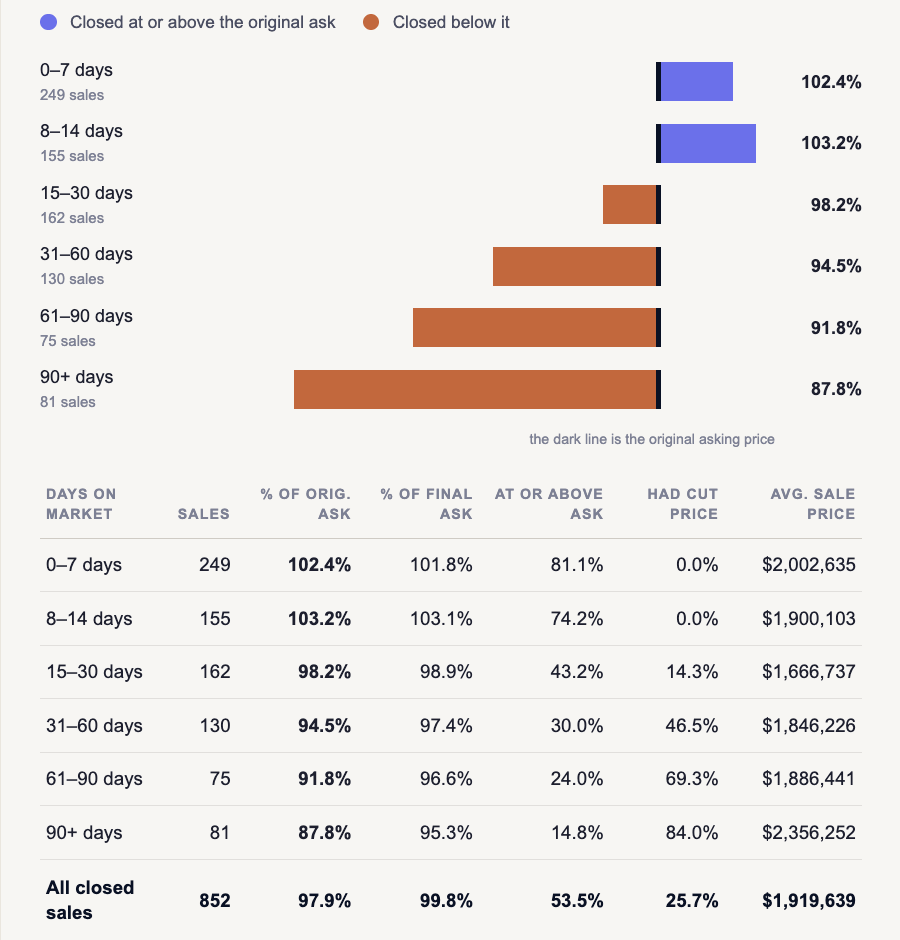
The numbers tell a pretty consistent story:
- 0–7 days: 102.4% of original asking price
- 8–14 days: 103.2%
- 15–30 days: 98.2%
- 31–60 days: 94.5%
- 61–90 days: 91.8%
- 90+ days: 87.8%
And by the time a home had been on the market 90 days, 84% had reduced their price.
The study is careful to point out that this is a relationship, not proof that time on the market itself causes a lower sale price. Condition, location, floor plan and other factors can all affect how a home performs.
But that's exactly why those factors need to be considered before the home is priced and put on the market.
And This Isn't Just About Expensive Homes
One question you might have is whether these results are simply because the more expensive homes took longer to sell.
The study broke the numbers down by price range, and the same pattern appeared across every price tier.
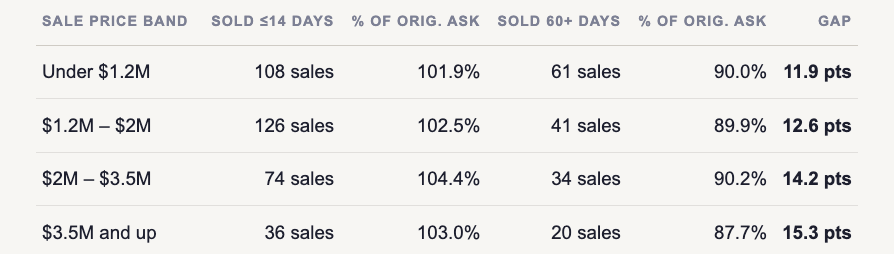
The gap between homes that sold quickly and those that took 60 days or more was:
- Under $1.2 million: 11.9 percentage points
- $1.2–$2 million: 12.6 points
- $2–$3.5 million: 14.2 points
- $3.5 million+: 15.3 points
So this isn't simply a story about higher-priced homes sitting longer.
What About Here in the South Bay?
The pattern shows up locally, too.
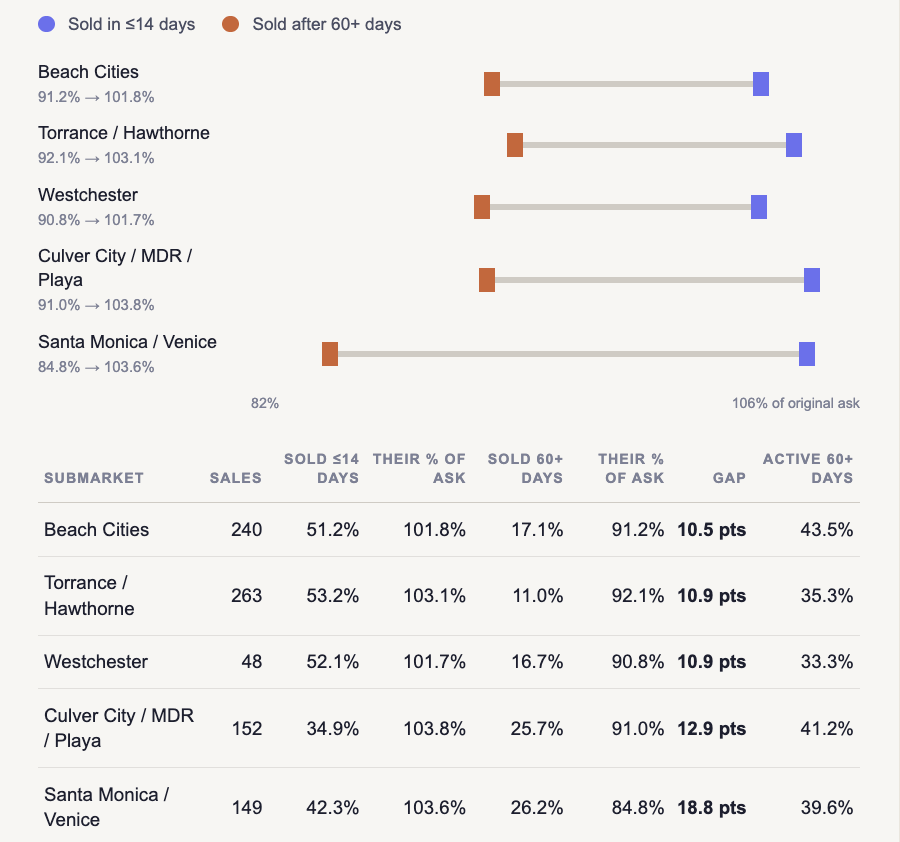
In the Beach Cities, homes that sold within the first two weeks averaged 101.8% of their original asking price, compared with 91.2% for homes that took 60 days or more.
In Torrance and Hawthorne, the numbers were 103.1% for homes selling within two weeks versus 92.1% for homes taking 60 days or more.
That's why local pricing matters. Your home isn't competing against a national average. It's competing against the homes buyers are actually seeing and comparing right here in your market.
So What Happens When You “Price High and See What Happens?”
The study also looked specifically at 790 sales where both the original and final asking prices were reported.
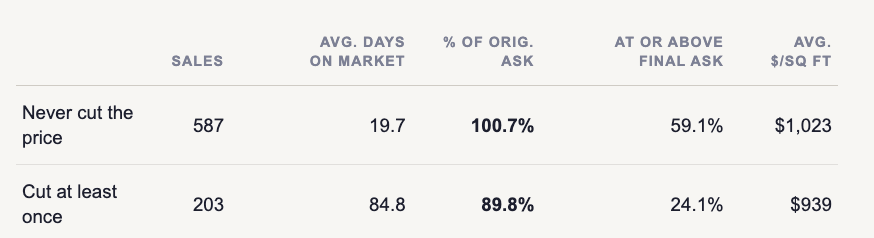
Of those:
587 homes never had a price reduction.
- Average time on market: 19.7 days
- Average sale price: 100.7% of original asking
- Average sale price per square foot: $1,023
203 homes had at least one price reduction.
- Average time on market: 84.8 days
- Average sale price: 89.8% of original asking
- Average sale price per square foot: $939
The homes that had a price reduction took more than four times as long to sell on average.
Again, that doesn't mean the price reduction itself caused the lower result. But it does reinforce the importance of getting the initial strategy right.
What Does This Mean If You're Thinking About Selling?
The takeaway isn't that every home should be priced low.
It's that the initial pricing strategy matters.
Condition, location, floor plan, updates, competition and recent sales should all be part of the conversation before your home ever hits the market.
Those aren't things you want to discover after your home has been sitting for 60 or 75 days. They should be reflected in the pricing strategy from the beginning.
The goal isn't to have a plan for fixing the price after you've spent weeks on the market. The goal is to have the right strategy before you ever put the house on the market.
The Bottom Line
Pricing a home isn't about being the highest or the lowest. It's about understanding what the market is telling you before you put the home on the market and using the specific characteristics of your property to determine the right strategy.
Condition, location, floor plan, updates, competition and recent sales all matter. Those aren't things you want to discover after your home has been sitting for 60 or 75 days. They should be part of the pricing conversation from the beginning.
After 19 years in this business, I know every home is different. There isn't one formula that works for every property, which is why local knowledge and a thoughtful pricing strategy matter.
If you're thinking about selling, I'd be happy to look at your specific neighborhood, the current competition and the recent sales and talk through what the numbers actually mean for your home.