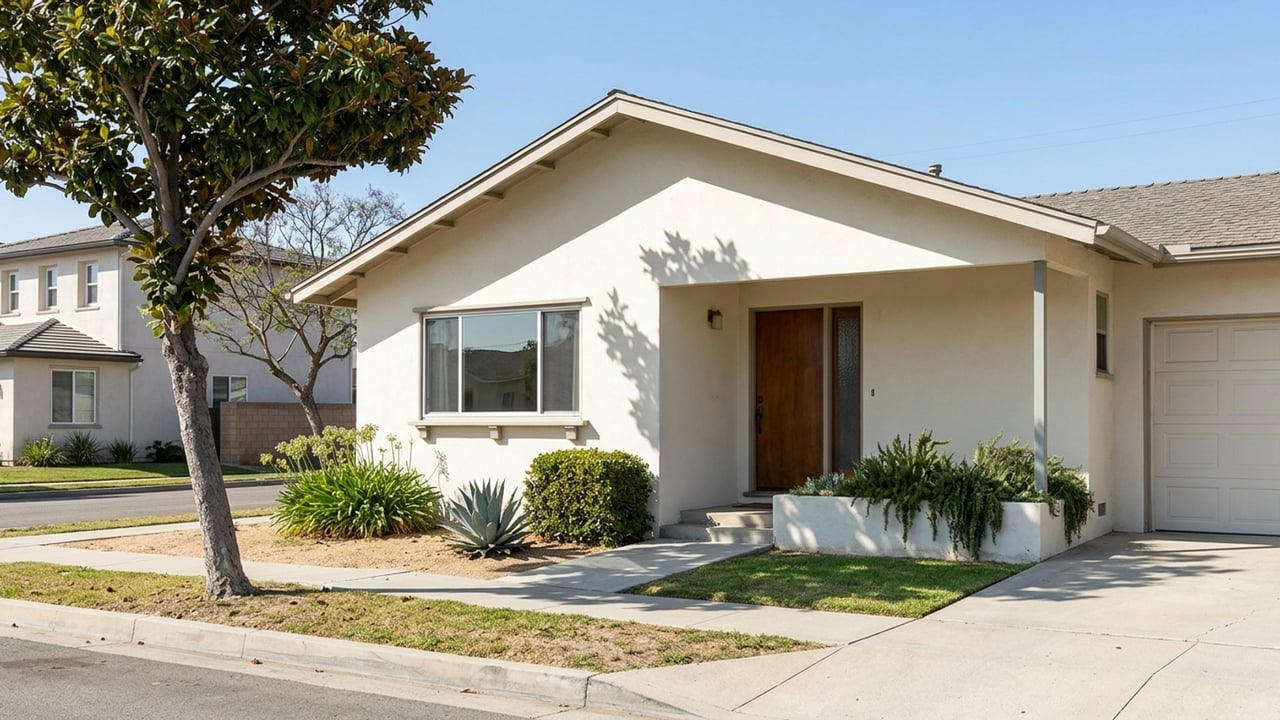
In Torrance, the portion of your closing bill you can't change scales with the sale price. The portion you can control depends entirely on your property type. Closing costs are the fees and taxes pulled from your sale price in escrow before you see a dollar of proceeds.
The median sale price for a home in Torrance is currently around $1,174,000. At that price point, a small percentage shift in fees is thousands of dollars in net proceeds. Know who pays for what before you get to the closing table.
Key takeaway
Most of a Torrance seller's closing bill is set by the sale price, including commission, the owner's title policy, escrow, and the county transfer tax. The part you can move depends on what you're selling. With 49.4% of single-family homes selling above list in the 90 days ending September 30, 2026, a house seller can usually refuse buyer credits, while a condo seller should budget for a credit and a longer listing.
Who this guide is for
You own a home in Torrance and are working out what selling it will cost at closing and what you'll walk away with.
What are seller closing costs in Torrance?
The split here is worth understanding up front. Single-family homes recently sold above list with 1.5 months of supply, so house sellers can generally refuse credits. Condos sold below list with 3.9 months of supply and a 51-day median, which means condo sellers should budget for a credit and an extra month of HOA dues. Those two markets behave differently, and your closing estimate should reflect that.
Closing costs are the specific fees and taxes deducted from the sale price in escrow before you receive your proceeds. Your mortgage payoff also comes out of those proceeds, but it's a debt repayment rather than a closing fee. If you're comparing a cash offer to a financed one, the fee structure looks different.
According to the California Department of Insurance, Southern California custom dictates that the seller pays the premium for the owner's title insurance policy. Sellers also customarily pay the county transfer tax and the agreed-upon real estate commission. Escrow fees are often split between buyer and seller, though every split is negotiable in the purchase contract.
Seller closing costs line by line
Southern California handles title and escrow separately, using independent escrow companies, banks, or title companies. The specific line items on your closing statement fall into four main categories, and each one behaves differently depending on the sale price and what you negotiate with the buyer.
Real estate commissions
This is the largest line item, and it's the one you set by contract. Following the 2024 National Association of REALTORS® settlement, the listing commission and any offer toward the buyer's agent are separate, explicit decisions. MLS participants working with buyers must enter into a written agreement disclosing their compensation before touring a home, and offers of compensation to buyer brokers can no longer appear on the MLS.
On a median-priced Torrance house, every percentage point of commission is about $13,300. More precisely, each point at the single-family median is $13,294.70, and at the condo median it's $6,929.29. Check your listing agreement for the commission rate and any terms about compensation to a buyer's agent.
Declining to offer anything toward the buyer's agent lowers this line on paper. Buyers may then ask for the same amount as a closing-cost credit in their offer, so read the purchase contract carefully before counting those savings.
Title insurance and escrow fees
The owner's title policy premium is based on the sale price under rates filed with the state. California title insurers must file their rates with the California Department of Insurance, and it's unlawful for them to charge less than their currently effective schedule. Escrow fees vary by company and are often split with the buyer.
Your closing statement will also include smaller add-on charges in this section: sub-escrow, notary, wire, and courier fees. Ask your escrow officer for a written seller net sheet with current title and escrow quotes for your expected price.
Who picks title and escrow, and how the escrow fee is split, are contract terms, not law. A buyer-written contract can shift more of these charges onto you if you don't counter.
Documentary transfer tax and recording fees
Los Angeles County levies a documentary transfer tax of $1.10 per $1,000 of the sale price. Torrance is a charter city that imposes its own transfer tax of $0.55 per thousand, but the county credits that amount against its own tax. The result: Torrance's combined county and city transfer tax totals that same rate.
Torrance sellers don't pay Los Angeles's Measure ULA "mansion tax" because Torrance is its own city. Recording fees for the lender's reconveyance are set by the county, with a standard one-page deed totaling $99.
This is the one line you can't negotiate down. It's due at closing regardless of how the rest of the deal is structured.
Reports, prorations, and HOA fees
California law requires sellers of one-to-four unit properties to deliver a Natural Hazard Disclosure (NHD) report showing whether the home sits in specific flood, fire, or seismic zones. You'll also see property tax prorations based on LA County's two-installment calendar. The first installment is due November 1 and the second is due February 1, so pull your latest bill to see which installments are paid.
For condo and townhouse sellers, state law requires the HOA to itemize the fees it charges a seller for resale documents. The association may collect a reasonable fee based on the actual cost to prepare and deliver those documents. Confirm in the purchase contract who pays for the NHD report, termite inspection and clearance, and any home warranty.
Prorations and HOA charges are the costs sellers tend to forget. Unpaid tax installments, past-due dues, or a special assessment balance come straight off your proceeds at closing.
How your property type changes the bill
Single-family homes are moving quickly, with 1.5 months of supply and a 29-day median on market. That short carrying time means less pressure to fund buyer costs. Townhouses sit at a 40-day median and are down 4.7% year over year in price, so expect some negotiation there.
Condos are a different story. With 3.9 months of supply and a 51-day median, budget for an extra month or more of mortgage payments, HOA dues, and utilities while listed. The condo median rests on a smaller base of 35 sales, but the longer market time points clearly in one direction.
Flat fees like HOA documents and the NHD report also take a bigger proportional bite out of a condo sale. The costs that grow the most for condo sellers tend to be the ones that don't show up on a standard estimate. Review Torrance housing market trends to see how these supply numbers shift over time.
Seller credits and repair requests in the 2026 market
A credit toward the buyer's closing costs is not the same as a price cut. A credit is paid from your proceeds at closing and is capped by the buyer's loan program. Repair requests differ from a flat repair credit, which simply gives the buyer funds to address an issue after closing.
Your negotiating position depends on the property. Single-family homes recently sold at 101.3% of list price, townhouses at 99.9%, and condos just below that. A house seller with competing offers can usually refuse a credit outright.
A condo seller may net more by offering a modest credit than by cutting the price, because a credit doesn't lower the recorded sale price. Pre-listing prep costs and home staging are paid before you list and aren't closing costs.
How to estimate your own seller closing costs
Start with the basics. Are you selling a single-family home, a townhouse, or a condo? That answer sets how much room to leave for credits. If your home has an HOA, ask the management company for its itemized resale document fee, any transfer fee, and confirmation of a zero balance. Know what commission rate you agreed to and whether you'll offer anything toward the buyer's agent. Finally, note whether the home is your primary residence or an investment property, since that changes withholding and tax treatment. Review the standard steps for selling a home in Torrance to prepare for the transaction.
On a median single-family home ($1,329,470), each percentage point of commission is $13,294.70. The county transfer tax comes to $1,462.42. On a median condo ($692,929), each point of commission is $6,929.29, and the transfer tax is $762.22.
From there, add the title and escrow fees from a net-sheet quote, prorations, and any HOA items. Subtract your loan payoff from the remaining amount to reach your net proceeds. Request a payoff statement from your lender, which includes interest through the payoff date and any fees. Mercedes Van Pelt can prepare a net sheet for a specific Torrance address to give you exact figures before you list.
At a glance
- All homes in Torrance: median sale price $1,174,441, down 4.9% year over year, 266 sales, median $717 per square foot (90 days ending 2026-09-30)
- Single family: median sale price $1,329,470, down 0.8% year over year, 177 sales, median $824 per square foot (90 days ending 2026-09-30)
- Single family: 101.3% sale-to-list, 49.4% sold above list, 29 median days on market, 1.5 months of supply, 88 active listings (90 days ending 2026-09-30)
- Townhouse: median sale price $871,510, down 4.7% year over year, 49 sales, median $613 per square foot (90 days ending 2026-09-30)
- Townhouse: 99.9% sale-to-list, 27% sold above list, 40 median days on market, 2.2 months of supply, 35 active listings (90 days ending 2026-09-30)
- Condo: median sale price $692,929, up 2.7% year over year, 35 sales, median $609 per square foot (90 days ending 2026-09-30)
- Condo: 99% sale-to-list, 23.5% sold above list, 51 median days on market, 3.9 months of supply, 44 active listings (90 days ending 2026-09-30)
Torrance seller closing costs FAQs
Are sellers in Torrance paying buyers' closing costs in 2026?
It depends on the property type. In the 90 days ending September 30, 2026, only 23.5% of condos and 27% of townhouses sold above list. Credit requests are more likely on those properties than on single-family homes, where nearly half sold above list.
How much can a seller give toward a buyer's closing costs?
Limits depend on the buyer's loan program. Fannie Mae permits interested party contributions ranging from 2% to 9% of the property value, depending on occupancy type and the loan-to-value ratio. The Department of Veterans Affairs caps seller concessions at 4% of the home's reasonable value, and a credit can never exceed the buyer's actual closing costs.
Is $20,000 in seller closing costs a lot in Torrance?
No. $20,000 is about 1.7% of the $1,174,441 median sale price for all homes in Torrance, and commission alone usually exceeds that amount at Torrance prices. The better question is which specific lines make up your total on a seller net sheet.
How much are seller closing costs on a $500,000 home in California?
Commission is the largest variable: at that price, each percentage point costs $5,000. The combined LA County and Torrance transfer tax equals $550. Title and escrow fees would come from a filed-rate quote, though no Torrance property type currently has a median price that low.
What is not included in seller closing costs?
Your mortgage payoff and any home equity lines are debts paid from the proceeds, not closing costs. Moving costs, pre-listing repairs, staging, and capital gains tax are also excluded. Your payoff statement will show the exact interest and fees owed through the payoff date.
What seller closing costs are tax deductible?
Selling expenses such as commission and transfer tax generally reduce your amount realized rather than acting as standard deductions. IRS Publication 523 states that if you meet certain conditions, you may exclude the first $250,000 of gain from your income, or $500,000 for certain joint filers. Ask a tax professional whether you qualify. This page is general information and not tax advice.
Do California sellers have money withheld for state taxes at closing?
Yes. California requires real estate withholding, which is generally 3.33% of the total sales price collected by escrow on Form 593. This is a prepayment held from proceeds, not a closing fee. A seller may claim an exemption for a principal residence or when the property is part of a 1031 exchange.
Are closing costs a rip-off, or can a seller shop for lower fees?
Some lines are fixed by law: the $99 standard recording fee and the county transfer tax aren't going anywhere. Title premiums follow rates filed with the California Department of Insurance, but escrow fees and commissions do vary. You can get two escrow quotes before agreeing to a contract term that assigns the escrow company.
Sources
- Redfin: Data Center
- California Department of Insurance: Title Insurance
- National Association of REALTORS: Summary of 2024 MLS Changes
- Code Publishing: Torrance Municipal Code Chapter 24
- Wikipedia: Measure ULA
- California Legislative Information: Civil Code §1103
- California Legislative Information: Civil Code §4530
- Fannie Mae: Selling Guide B3-4.1-02
- VA: Funding fee and closing costs
- IRS: Publication 523
- California Legislative Information: RTC §18662